How Do I Check If ChatGPT Recommends My Remodeling Company?
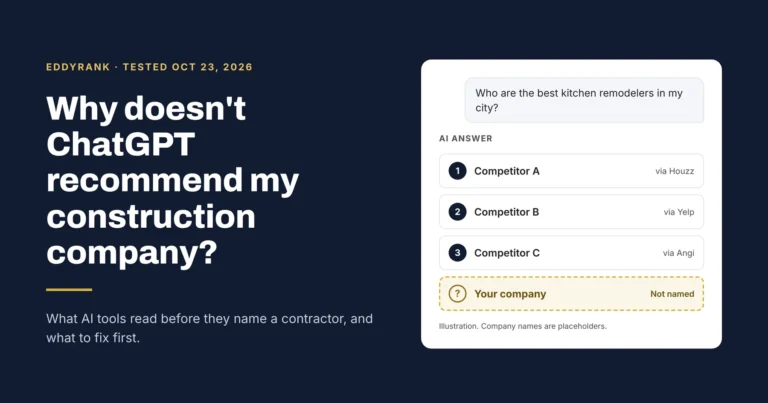
A homeowner in your town opens ChatGPT and types, “Who should I hire to remodel my kitchen?” Three or four company names come back. If yours isn’t one of them, that job is gone before anyone visits your website or picks up the phone. If you’re asking, How do I check if ChatGPT recommends your remodeling company?
Then here’s the short answer: you can check where you stand in about five minutes. Open a fresh, logged-out ChatGPT chat, ask the questions your customers ask without typing your company name, and log who gets named, why, and which sources the answer cites. Then repeat the same prompts every week, month, or quarter.
I run this check on my own sites and for one client using this AI visibility checker. Below is the exact test, what it turned up between August and October 2026, and what to fix first.
The 3-prompt test I run to see if ChatGPT recommends a remodeler
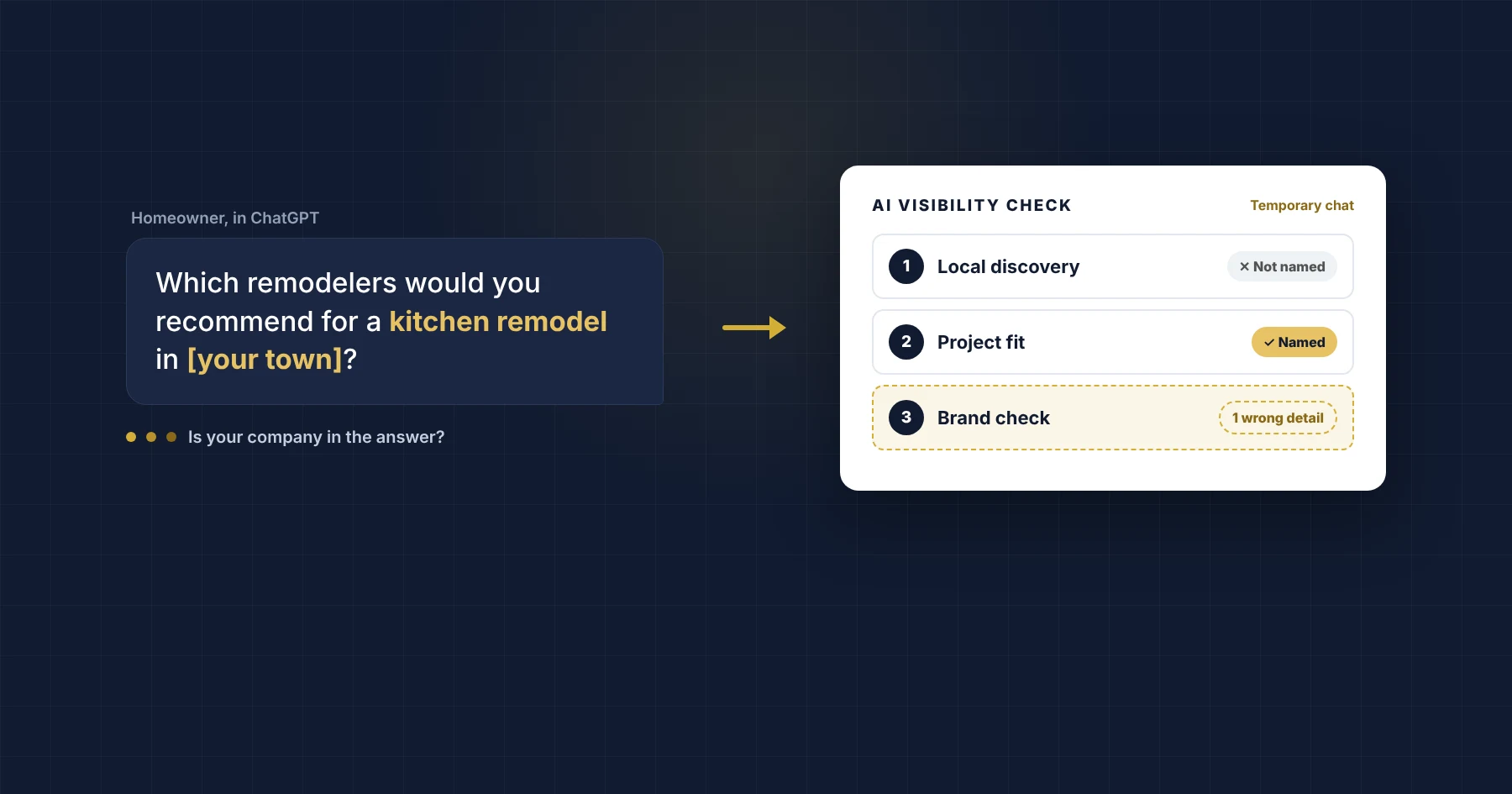
- Ask like a homeowner. “Which remodelers would you recommend for a kitchen remodel in [your town]?” Fresh chat, logged out, no company name.
- Add the job details. Permits, design-build, HOA rules, whatever your customers bring up.
- Then ask about your company by name. Circle every wrong phone number, town, service or license detail.
What I learned: on Aug 9, 2026 Google AI Mode named my client and ChatGPT didn’t, for the same prompt. In October my Costa Mesa site ranked #1 on Google and no AI answer named it. Test every platform, and log the date.
What I found when I tested it
I track AI answers for my own sites and for one client, a family-run Los Angeles design-build firm. Three results changed how I run this check.
Same question, different AI, different answer
| Date | Prompt (no brand name) | Platform | Named? | What the answer leaned on |
|---|---|---|---|---|
| Oct 27, 2026 | “How to choose a kitchen remodeling contractor in Costa Mesa?” | ChatGPT | ✕ Not named | Four local firms from directory ratings (one had a single review), CSLB pages |
| Oct 22, 2026 | Same prompt | Google organic | Ranked #1 | My kitchen remodeling site |
| Oct 22, 2026 | Same prompt | Claude, Perplexity, Google AI Mode | ✕ Not named | HomeGuide, Thumbtack, CSLB, City of Costa Mesa |
| Oct 21, 2026 | “How do I find out if ChatGPT recommends my remodeling company?” | ChatGPT, AI Mode, Perplexity, Claude | ✕ Not named | EddyRank isn’t named yet, which is part of why this post exists |
| Aug 9, 2026 | “design and build contractors” (Los Angeles) | Google AI Mode | ✓ Named, 2nd of 6 | Google Maps listings, Angi, Architectural Digest, CSLB |
| Aug 9, 2026 | Same prompt, same day | ChatGPT | ✕ Not named | 10 other firms; all eight citations were contractors’ own homepages |
| Aug 9, 2026 | Same prompt | Google map pack | Best spot #14 | Found in 4 of 9 grid points |
How I ran these: each prompt went through my rank tracker with no company name in it. Rows are newest first. Results change, so every row carries its date.
One prompt on one day gave two different answers about the same contractor. Google AI Mode recommended my client while ChatGPT never mentioned them. Their map pack position was #14, well outside the 3-Pack, and Google’s AI still named them.
The Costa Mesa result humbled me. My kitchen remodeling site was #1 on Google for that question. Claude read two of my pages while researching its answer, then cited HomeGuide and a local contractor instead. My tracker marked that as a “mention.” I don’t count it, because a homeowner reading the answer would never see my name. When I reran the prompt in ChatGPT on October 27, it named four local firms, including one with a single review, and still left my site out.
Why does ChatGPT name some remodelers and skip others?
ChatGPT recommends the companies it can find, read and trust in the sources it checks during that chat. It doesn’t keep a fixed ranking of contractors.
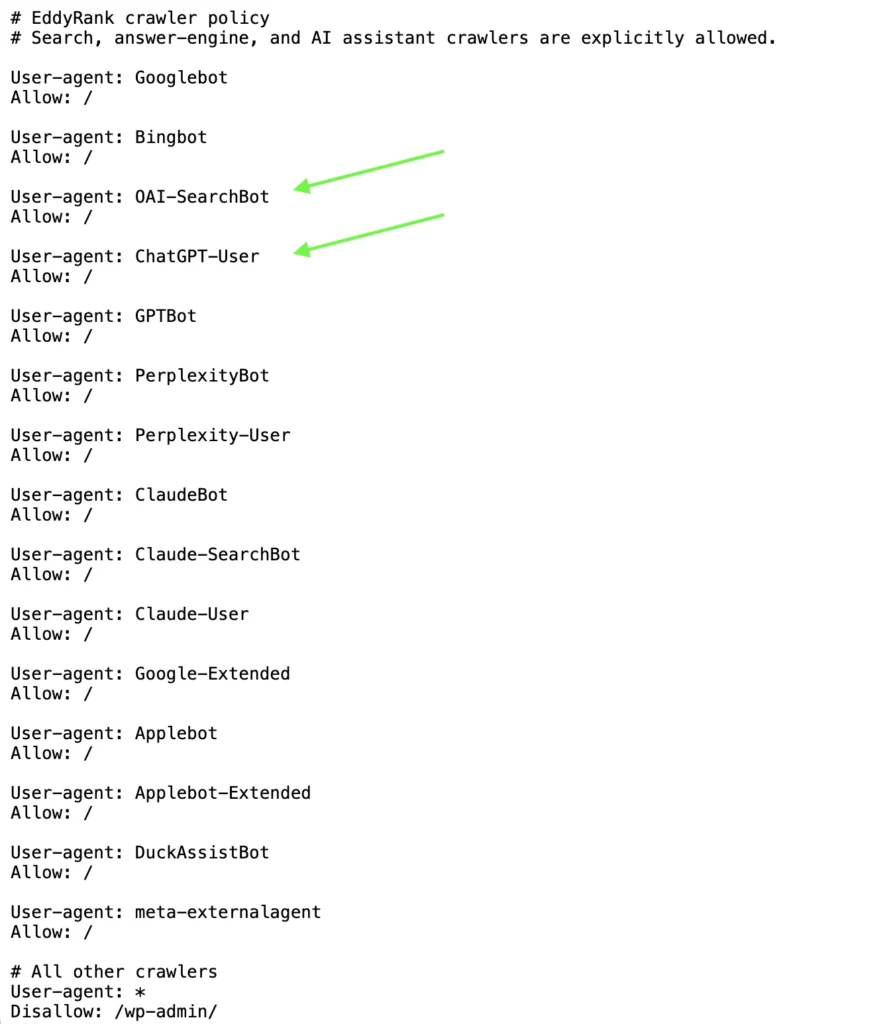
When ChatGPT searches the web, OpenAI’s crawler, OAI-SearchBot, determines which sites can show up. OpenAI’s crawler docs say sites that block it in robots.txt won’t appear in ChatGPT search answers. Your web person can check that in two minutes.
In my August LA test, ChatGPT cited the contractors’ own websites for every firm it named. Google AI Mode leaned on Google Maps listings, an Angi profile and an Architectural Digest roundup. On the same day, the two platforms answered from two different sets of sources.
Four platforms, four different source lists
ChatGPT
Tested Aug 9 and Oct 27, 2026
Leaned on
In LA, all eight citations were the contractors’ own websites. Your site has to say what you do, where, clearly.
Google AI Mode
Tested Aug 9 and Oct 22, 2026
Leaned on
Named my client from Google Maps, even at #14 on the map. Your Google listing carries this one.
Claude
Tested Oct 22, 2026
Leaned on
Read two of my pages while researching, then cited HomeGuide instead.
Perplexity
Tested Oct 22, 2026
Leaned on
Also pulled Houzz, Angi and BBB pages while searching. Directory profiles feed this one.
From my tracked tests in Los Angeles (Aug 9, 2026) and Costa Mesa (Oct 22 and 27, 2026). The one source every platform used for the licensing step: the CSLB.
Google says its local results run on relevance, distance and prominence. Don’t assume ChatGPT uses the same formula. The Bing index is one route worth checking, but it doesn’t explain every ChatGPT answer. You have to test each platform separately. I covered the most common reasons in why ChatGPT skips some contractors.
How do I set up a fair test?
Use a clean chat, your real service area, and wording a homeowner would type.
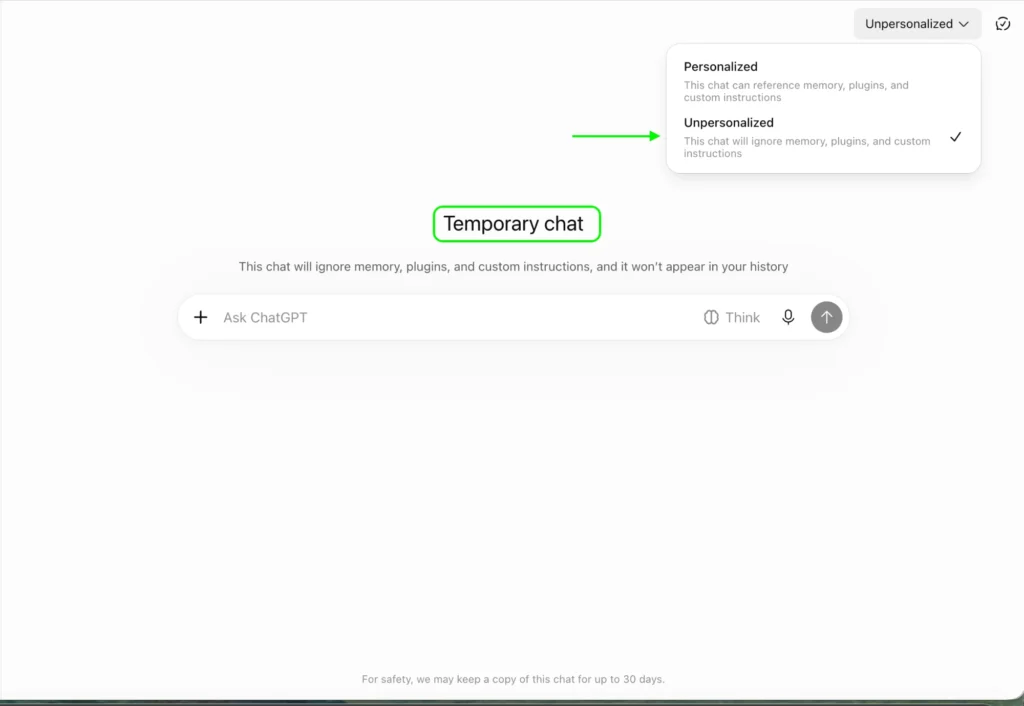
- Start fresh. In ChatGPT, open a Temporary chat and switch it to Unpersonalized (top right). That ignores memory, plugins and custom instructions, and the chat stays out of your history. A private browser window, logged out, works too. Neither guarantees a neutral answer, but both cut down on old context steering the reply.
- Leave your name out. Start with the job and the town. A question that includes your company name tests whether ChatGPT knows you, which is a different question from whether it would recommend you.
- Use the towns you want jobs in. Pair them with the work you want more of: kitchen remodeling, bathroom renovation, home additions, basement finishing.
- Talk like a homeowner.
GeneralContractoris a structured-data label. Homeowners type “who should I hire to redo my kitchen.” - Log everything. Make a spreadsheet with these columns: date, platform, model or search mode, exact prompt, companies named, reason given, sources cited, links, and accuracy notes.
Rerun the same prompts monthly or quarterly. If you change the wording, you can’t tell whether the answer moved or your question did. Save screenshots, including the citations.
Which three prompts should I run?
Run one discovery prompt, one project prompt and one brand prompt, each in its own fresh chat.
Copy these word for word. Swap in your town and job, and run each one in its own fresh chat.
- Local discovery Counts toward visibilityWhich remodeling companies would you recommend for a kitchen renovation in [Town, State]?Shows whether you come up for a local job and who comes up instead. Note whether the answer names firms, points to a directory, or avoids naming anyone.
- Project fit Counts toward visibilityI need a contractor for a [project type] in [Town, State]. What should I look for, and which local companies fit?Add the requirements your customers bring up: permits, HOA approval, design-build, accessibility, flood-zone rules. Don’t stack the criteria so the answer has to pick you.
- Brand check Accuracy onlyWhat can you tell me about [Company Name] in [Town, State]?Check the name, services, service area, phone, website, hours, reviews and license. If it comments on your review velocity (how fast new reviews come in), check the dates behind it.
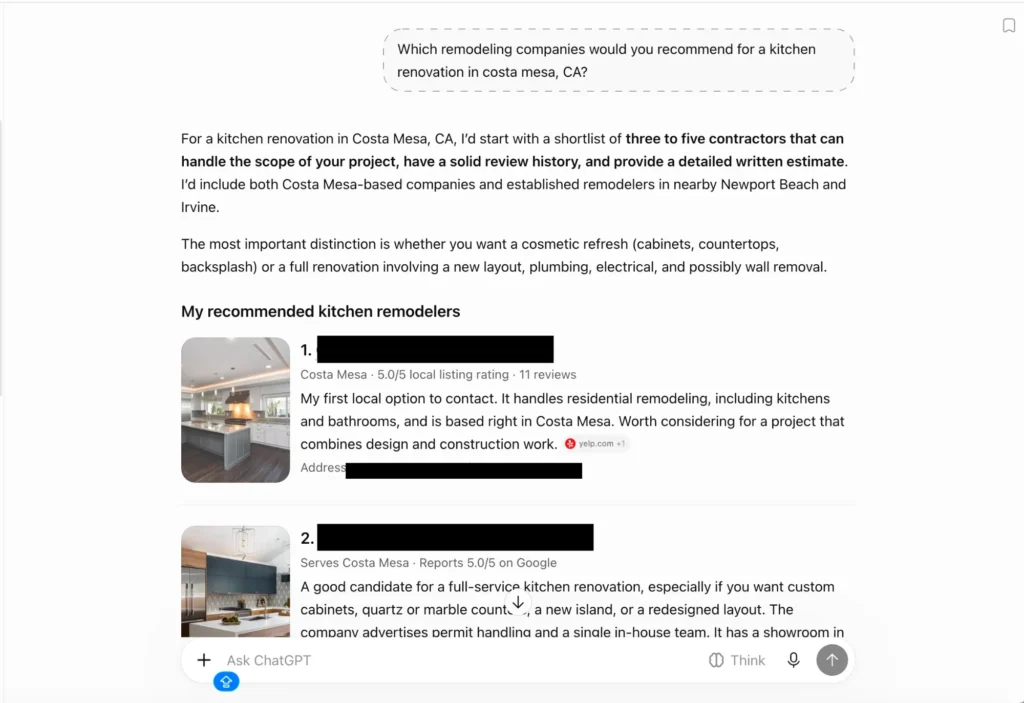
Prompt 3 measures what the AI knows about you. It doesn’t measure whether it would recommend you to a stranger, so keep it out of your visibility count.
How do I score what ChatGPT says?
Sort each answer into three buckets: named and accurate, named but wrong, or not named.
Your test-set mention rate is the number of unbranded answers that name you divided by the number of unbranded answers you ran. Label it that way, because it covers your test prompts and nothing wider.
Score every answer 0 to 2 on four things
Use the same definitions every month, so this month’s 6 means the same as last month’s.
Rule: a high score never cancels out a wrong phone number. Log serious errors on their own line, even when the answer puts you first.
Separate facts about your company from opinions in reviews. AI answers sometimes turn one reviewer’s comment into a company specialty. In my LA test, AI Mode listed my client’s specialty as layout permitting and multi-story additions. I checked with the owner, and it was right. Check every claim like that against the job list you actually run.
Check the competitors who keep getting named. Look at their cited service pages, project galleries, Houzz and Yelp profiles, and BBB listings. If a competitor appears, inspect their evidence. It doesn’t prove they do better work.
Where does the AI get its information about my company?
From your website, your listings, review sites and directories, and the details need to match across all of them.
Check your core business details
Compare your name, address or service area, phone, website, hours, categories and services across:
- Google Business Profile and Google Maps
- Bing Places and Apple Business Connect
- Facebook, Yelp, BBB, Houzz, Angi and HomeAdvisor
- Your state license board (in California, the CSLB) and any trade directories
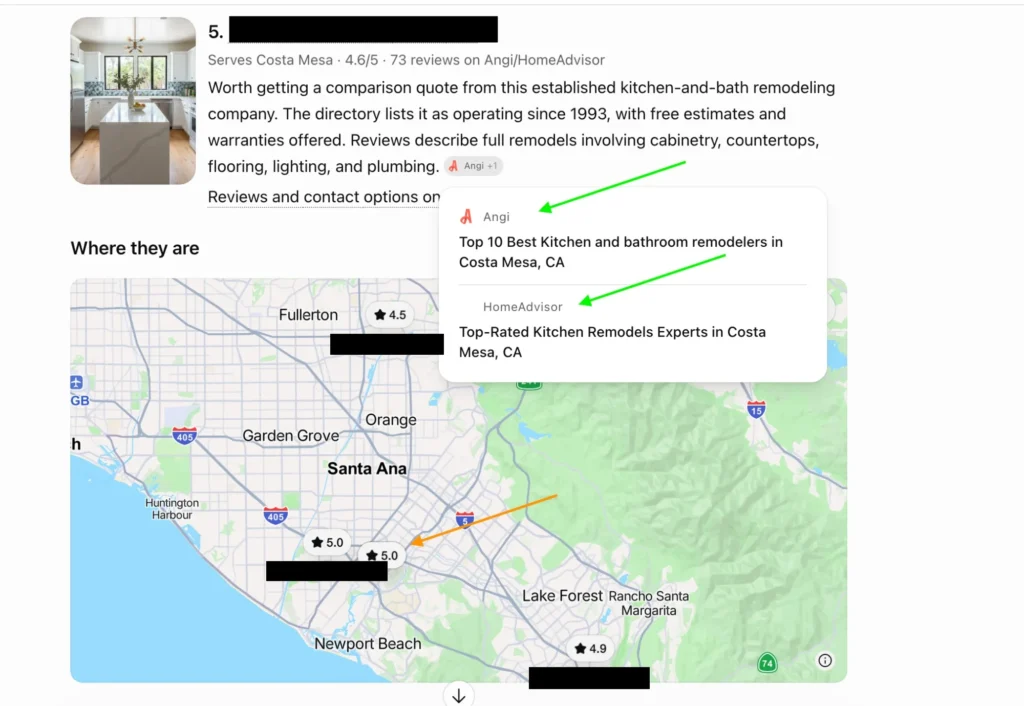
Every Costa Mesa and LA answer I tracked told homeowners to look up the license on the CSLB. If your license name doesn’t match your website name, a homeowner may stop there. Fix old details after a move, a new phone number, a merger or a rebrand.
Make your website easy to read
Give each service its own page: kitchens, bathrooms, additions, ADUs. Each page should answer the questions homeowners ask on a walkthrough: scope, permits, process, timeline and what changes the price. Use real project photos and say clearly which towns you serve. Only publish cost ranges you can explain.
This is what AEO, answer engine optimization, means in plain English: set up your pages so AI tools can pull a clear answer and credit you for it.
Use structured data carefully
Add LocalBusiness markup with the right subtype, such as HomeAndConstructionBusiness or GeneralContractor. Include your real contact details and service area, and add a sameAs field that links to your official profiles. The markup has to match what’s on the page.
Use FAQPage only for real FAQs that visitors can see. Google stopped showing FAQ rich results in Search on May 7, 2026, per its FAQPage documentation, though other systems may still read the markup. Structured data won’t guarantee an AI recommendation.
Should I check Google AI Mode, Gemini and Perplexity too?
Yes. Homeowners use more than one, and in my tests each platform cited different sources.
Run the same prompts in Gemini, Perplexity, Google AI Overviews, Google AI Mode and Microsoft Copilot. Keep the town, job type and criteria the same, and record each platform on its own row. AI Overviews don’t show up for every search. If none appears, record “no overview” rather than “missed.”
Watch for three patterns:
- Whether you show up for the same job and town on more than one platform
- Whether the same wrong fact keeps showing up, which usually points to one outdated page
- Whether several platforms cite the same source, like Houzz or Thumbtack
Treat tools as a helper, not the final word. Ahrefs Brand Radar tracks mentions, citations and AI share of voice. Semrush’s AI Visibility Toolkit tracks visibility, competitors, prompts and cited sources. Or you can run my free AI visibility check, which will check 6 different AI platforms for up to 4 prompts.
My Costa Mesa test is the reason I still read the answers by hand. The tracker called it a mention, but the answer itself never named me.
Report your Google map rank and your AI mentions separately. My LA client was #14 on the map and named by AI Mode on the same day.
Your 5-minute self-check
- Open a private window and go to ChatGPT, logged out.
- Type: “Which remodelers would you recommend for a [your main job] in [your town]?”
- Screenshot the answer and the sources.
- Open a new chat and ask: “What can you tell me about [your company] in [your town]?”
- Circle every wrong detail: phone, town, services, license, hours.
If you’re missing from step 2 or anything is circled in step 5, you have your first fix.
What to fix this month
Start with errors that could send a homeowner to the wrong company or set the wrong expectations for the job.
Fix firstCosts you calls this week
- Wrong phone number, town or hours on any listing
- Missing Google Business Profile, Bing Places or Apple Business Connect profile
- Service claims you can’t back up
- License name or number that doesn’t match your website
Fix nextMakes competitors easier to pick
- Thin service pages with no project details
- No completed-job photos or project write-ups
- Directory descriptions that don’t match each other
- Reviews with no response
When you canLow impact
- Small wording differences that don’t change how a homeowner judges fit
Give each fix an owner and a due date. “Fix the service area on Houzz by Friday” will get done. “Improve AI visibility” won’t.
If you’re an NKBA member, check that your listing in the National Kitchen & Bath Association directory is current. Don’t sign up for memberships only to fill a gap.
Consistent details plus real project proof help AI tools connect your company to your services and towns. Marketers call that entity authority. It describes what you’re aiming for, and no one can promise a ranking from it.
After you make real corrections, rerun the same prompts and compare.
What this won’t fix
- No guarantees. No agency, tool or tactic can promise a ChatGPT recommendation for every prompt. Models change, sources change, and every homeowner’s chat is different.
- One test isn’t a trend. One good answer doesn’t mean you’re visible, and one miss doesn’t mean you’re invisible.
- Ranking #1 on Google won’t carry over on its own. My Costa Mesa site proved that in October.
- Shortcuts backfire. Fake reviews, made-up credentials, misleading schema and copied competitor pages put bad information in front of homeowners. They also ruin your own test data.
Want me to run this check for you?
I’ll run your company through ChatGPT, Perplexity and Google AI Overviews and show you what they say: who gets named, who gets named instead of you, and which sites they’re pulling from. If you want me to dig through all of it personally, the full audit covers 3–5 homeowner questions across six AI platforms, with prioritized fixes.
- ChatGPT, Perplexity & Google AI
- Who gets named instead of you
- Which sources the AI cites
- Full audit ready within 48 hours
Full audit: $97 one-time · money-back guarantee
Run the free check or see the $97 auditFrequently asked questions
How can I test whether ChatGPT recommends my remodeling company?
Ask realistic questions about remodelers in your town and your type of job, and don’t use your company name. Repeat them in fresh, logged-out chats, then record whether you’re named and why.
What should I record when I check ChatGPT?
Save the exact prompt, date, platform, location, job details, companies named, the reasons given, citations and links. Note any wrong facts and the model or search mode so later checks have context.
Why does Google AI Mode name my company but ChatGPT doesn’t?
They pull from different sources. In my August 9, 2026 test, AI Mode leaned on Google Maps listings while ChatGPT cited contractors’ own websites, and only AI Mode named my client.
Does ranking #1 on Google mean ChatGPT will recommend me?
No. In October 2026 my Costa Mesa kitchen site ranked #1 on Google for a homeowner question, and none of the AI answers I tracked named it.
What should I do if ChatGPT doesn’t recommend my company?
Run several realistic prompts before you draw conclusions. Then check your service pages, listings, project photos, reviews and contact details, or get a free AI visibility check to find the gaps.
How often should I recheck?
Monthly, or quarterly at minimum. Use the same prompts each time, and recheck after big changes like a rebrand, a move or a new website.
Last tested: October 27, 2026.